
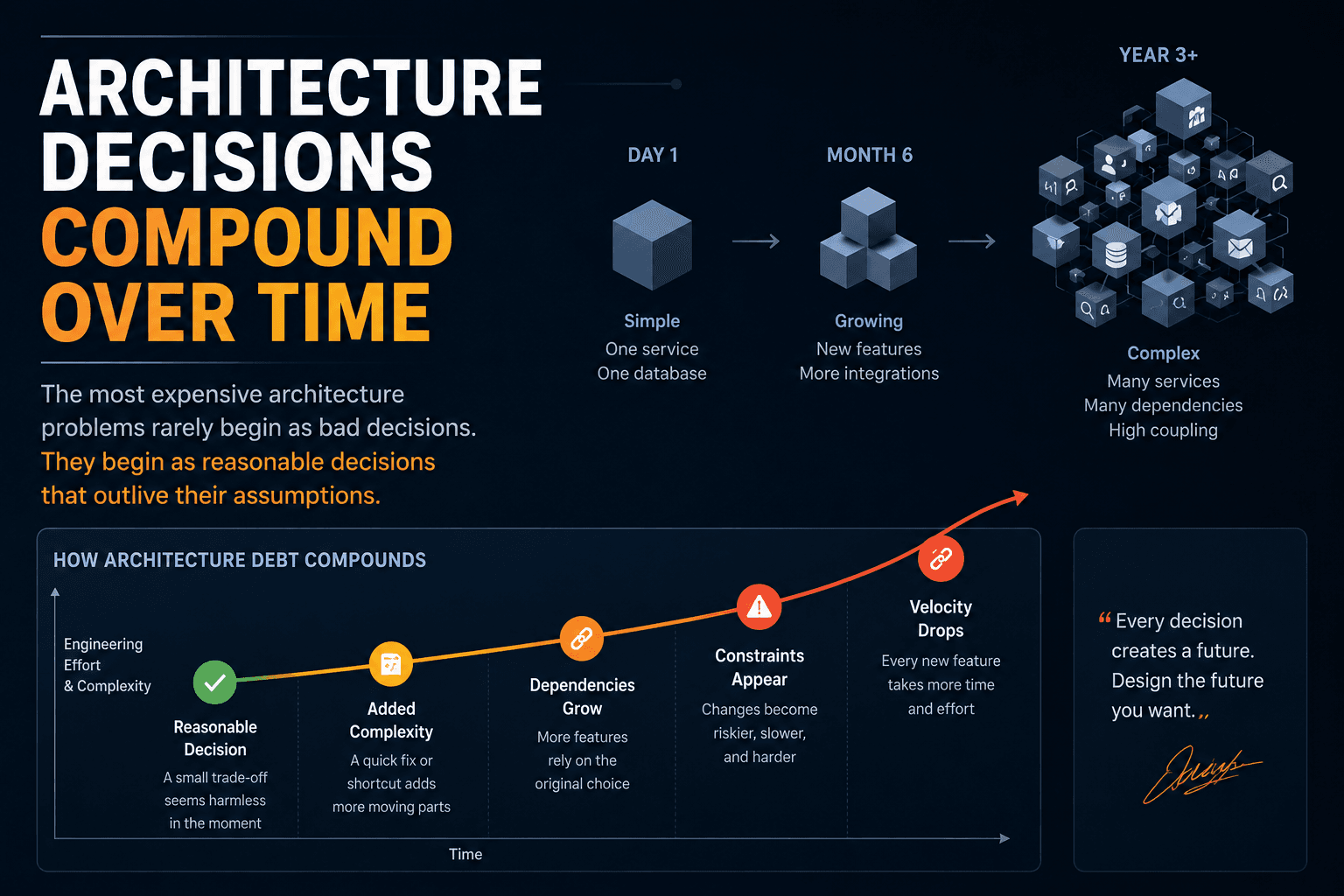
Architecture Decisions Compound Over Time
Every architectural decision is a bet on the future. Most bets are wrong - not because the decision was bad, but because the world changed. Here's how small choices accumulate and how to make decisions that age well.
I was six months into building a document processing pipeline when I realized the abstraction I'd chosen was now the single biggest obstacle to shipping features. What had started as a clean separation between ingestion, parsing, and storage had grown into a monolithic orchestration layer - not because anyone planned it that way, but because every quick fix, every "we'll refactor later," every boundary-pushing edge case treatment had pushed the system in one direction until it could not bend anymore.
That pipeline is still running in production today. It works. Nobody wants to touch it.
That's the thing about architecture decisions. They don't announce themselves as turning points. They arrive as pull requests that seem perfectly reasonable - a new configuration flag here, an optional parameter there, a slight deviation from the interface contract because the alternative would require changing three other services. Each change is the right call in isolation. But their aggregate trajectory is a direction nobody voted for.
Every Decision Is a Bet
When I commit to an architectural choice, I am placing a bet on a specific set of assumptions about the future. I am betting that this particular database will still be the right tool in two years. I am betting that the team will grow in a certain direction. I am betting that the business domain will not shift under my feet. And I am almost always wrong - not because I made a bad decision, but because the world moved.
Let me be precise about what I mean by "wrong." A decision that was optimal at the time can become a net negative later without anyone having been careless. The event sourcing system that perfectly captured every state change in the first year becomes a query nightmare in the third year when the read patterns look nothing like the write patterns. The microservice boundary that elegantly separated two concerns in the monolith era becomes a distributed transaction headache when the company grows and latency budgets shrink. The decision wasn't bad. The context changed.
// The decision that felt right at the time
interface DocumentProcessor {
  ingest(raw: Buffer): Promise<DocumentId>
  parse(id: DocumentId): Promise<ParsedDocument>
  store(parsed: ParsedDocument): Promise<void>
}

// Two years later, every caller needs to do this:
const id = await processor.ingest(buffer)
const parsed = await processor.parse(id)
await processor.store(parsed)
// ... but now there's also:
await processor.enrich(id)        // added for metadata
await processor.validate(id)      // added for compliance
await processor.notify(id)        // added for events
await processor.archive(id)       // added for retention
Each method was added for a legitimate reason. Each signature was backward compatible. But the clean interface I started with had become a god object by accretion, not by design.
The mindset shift that matters is this: stop asking "is this the right decision?" and start asking "what is this decision betting on, and what happens when that bet expires?" The goal is not to make perfect decisions. The goal is to make decisions whose expiration is survivable.
The Anatomy of a Bet
Every architecture decision has three components: the assumption, the commitment, and the escape hatch. Most engineering teams exhaust their energy debating the assumption and executing the commitment. The escape hatch is treated as an afterthought - something to figure out in the migration phase that never comes.
The assumption is the bet itself: "this queue will handle our throughput for the next 18 months." The commitment is what you build: the producer library, the consumer worker pool, the monitoring dashboards, the operational runbooks. The escape hatch is the plan for when the assumption expires: the interface that decouples producers from the queue implementation, the consumer contract that doesn't leak queue-specific semantics, the data format that can be replayed into a different system.
I have watched teams build world-class commitments on assumptions that expired within a year. I have also watched teams preserve escape hatches that cost them nothing to maintain but saved them months when the bet expired. The difference was rarely technical skill. It was whether someone asked, during the design phase, "what happens when this is wrong?"
How Small Choices Become Constraints
Small architectural choices compound into constraints through four distinct mechanisms. Understanding these mechanisms is the prerequisite to managing them.
Coupling - The Obvious Trap
Tight coupling is the most visible compounding mechanism, but it rarely arrives as a grand design decision. It accumulates through a thousand small accommodations. A frontend component reads a field directly from the API response shape instead of mapping it through a view model. A service imports a shared domain model from another service's package instead of duplicating a simple data structure. A configuration file references another service's hostname directly instead of going through service discovery.
Each of these choices saves five minutes at the moment it's made. Each one creates an invisible dependency that will be discovered two years later during a migration that should have been straightforward.
# The five-minute shortcut
# service_a/config.py
SERVICE_B_HOST = "service-b.internal:8000"

# Six months later:
SERVICE_B_HOST = "service-b.internal:8000"  # still hardcoded
# A developer hardcodes it in a different config file
# Another developer adds a retry wrapper that assumes the host
# The deployment team adds a DNS alias that breaks the assumption
# Nobody knows why the system degraded on the last deploy
The cost of coupling is nonlinear. The first hardcoded dependency is invisible. The tenth is a deployment constraint. The fiftieth means you cannot change anything without changing everything.
Path Dependency - The Historical Anchor
Path dependency means that past choices constrain future options, regardless of whether those past choices are still relevant. This is not inherently bad - consistency and stability come from honoring prior decisions. But it becomes a bottleneck when the cost of changing direction exceeds the value of the change.
I worked on a system where the data model had been optimized for a specific reporting query that mattered in the first year of the product. By the third year, that query accounted for 0.3% of the database load, but the data model was still organized around it. Every new feature had to contort itself through a schema designed around a priority that no longer existed. Nobody could justify the rewrite because the system was working - but the system was working despite the architecture, not because of it.
-- The schema optimized for a query that now accounts for 0.3% of traffic
CREATE TABLE events (
    id UUID PRIMARY KEY,
    occurred_at TIMESTAMPTZ NOT NULL,
    -- The original query needed this index:
    event_type VARCHAR(50) NOT NULL,
    payload JSONB NOT NULL,
    source VARCHAR(100) NOT NULL,
    -- Four columns added over three years, all NULL-heavy:
    correlation_id UUID,
    tenant_id INTEGER,
    processed_at TIMESTAMPTZ,
    error_message TEXT
);

-- The index that made sense for the original query:
CREATE INDEX idx_events_type_occurred
ON events(event_type, occurred_at DESC);

-- The pattern most queries actually need now:
SELECT tenant_id, date_trunc('hour', occurred_at), count(*)
FROM events
WHERE tenant_id = 42
  AND occurred_at >= now() - interval '24 hours'
GROUP BY 1, 2;
The path dependency wasn't created by a bad decision. It was created by a good decision that outlived its context. The schema was right for year one. It was wrong for year three. The cost of changing it - migrating data, updating every query, retesting every path, rewriting the ingestion layer - exceeded the perceived benefit, so it stayed wrong.
Opportunity Cost - The Hidden Price
Every architectural choice uses up a budget: the budget of what the team could have been doing instead. This is the most difficult mechanism to evaluate because you never see the path not taken.
I have experienced this directly. My team spent four months building a custom workflow engine for our document processing system. It was a technically impressive piece of work - state machines, pluggable steps, retry policies, observability hooks. It solved our immediate problem elegantly. But during those four months, we did not improve our deployment pipeline, we did not address the growing latency in the notification service, and we did not migrate off the legacy authentication system that was becoming a security concern.
When I look back, the question is not "was the workflow engine good?" It was good. The question is "was the workflow engine the best use of four months?" I honestly cannot answer that. The alternative timeline is invisible. But I know that the opportunity cost of significant architectural work is almost always underestimated, because the cost is denominated in what you stop doing, not what you start.
# When estimating, I now ask myself:
# - What am I trading away by building this?
# - What existing problems get deferred?
# - What does the team stop learning?
# These questions rarely have clear answers.
# That's the point - the uncertainty itself is the signal.
Institutional Inertia - The Organizational Weight
Architecture decisions compound through organizations as team knowledge, operational habits, and cultural expectations. A decision to use a particular technology creates hiring preferences, training materials, monitoring patterns, and incident response playbooks. After enough time, the architecture is embedded in the organization's identity, not just its infrastructure.
I saw this with a team that had built extensively on a niche message queue. The queue had genuine strengths for their use case. But after three years, the organization had hired twelve engineers who specialized in that queue, had built a custom monitoring stack around it, and had designed their deployment strategy around its scaling characteristics. The queue had become an institutional anchor. When a new project emerged that would benefit from a different architecture, the path of least resistance was to use the same queue - not because it was the best technical choice, but because the organizational cost of doing anything else was too high.
Institutional inertia is the silent multiplier on architectural decisions. A technology choice that seems neutral today carries a long tail of organizational dependencies that compound over time.
The Compounding Timeline
Each phase in this timeline is invisible to the people living through it. The transition from foundation to accretion happens one pull request at a time. The transition from accretion to constraints happens the moment the migration cost exceeds the rewrite cost - a threshold that passes silently, without ceremony.
Recognizing When a Past Decision Is Now the Bottleneck
I used to think that recognizing a bad architecture decision was about technical judgment. I now think it is about signal detection. The signals are not in the code alone - they are in the team's behavior, the deployment cadence, the incident patterns, and the emotional response to the system.
Deployment Friction
The most reliable signal is how a deployment feels. When a system is healthy, deployments are boring. They are routine. They happen multiple times a day, they take minutes, and they produce no surprises. When a past decision has become a bottleneck, deployments become events. They require coordination across teams. They have rollback checklists. They take hours and produce incidents.
I have learned to watch for the gap between a code change's conceptual size and its deployment risk. A three-line configuration change that requires a full regression run, a canary deploy, and a rollback plan is not a three-line change. It is a signal that the architecture has concentrated risk in the wrong place.
# A litmus test I use with my teams:
# If this change goes wrong, what is the blast radius?
# If the blast radius is the entire system, the architecture
# has failed to contain the complexity of the decision.
#
# Healthy architecture:
# - Database schema migration? Blast radius: one bounded context
# - New API endpoint? Blast radius: one service
# - Queue consumer change? Blast radius: one consumer group
#
# Bottlenecked architecture:
# - Configuration change? Blast radius: the entire deployment
# - Library upgrade? Blast radius: every service that shares the dependency
# - Log level adjustment? Blast radius: production incident (yes, I've seen this)
Incident Patterns
Incident postmortems reveal the architecture's failure modes. When I review a set of postmortems from a system, I look for patterns in the root cause categories. If 60% of incidents trace to the same service, the same abstraction, or the same dependency, that is not bad luck. It is the architecture concentrating risk.
The more subtle signal is when incidents become increasingly complex to resolve. Early in a system's life, incidents often have clear causes and linear resolutions: a misconfigured timeout, a resource leak, a race condition. Late in a system's life, incidents layer multiple compounding factors: the timeout that was never tuned after a deployment topology change, the resource leak that only manifests under a specific request pattern that emerged six months after the code was written, the race condition that involves four services and two async workflows.
# Early-stage incident:
# Root cause: "connection pool exhausted because max_connections was too low"
# Fix: increase max_connections
#
# Late-stage incident:
# Root cause: "connection pool exhausted because the legacy v1 ingestion path
#   (which nobody remembers is still active) holds connections longer than
#   the v2 path, and the recent deployment of the notification service
#   increased the baseline connection count, and the database migration
#   from last quarter changed the query plan for the health check endpoint,
#   which now holds a row-level lock that cascades"
# Fix: "we're not sure, so we restarted the pool and opened a ticket"
The second incident is not a failure of operations. It is the system expressing the accumulated complexity of decisions that have outlived their context. The resolution was a restart because the true fix - untangling the layered assumptions - was not actionable on an incident timeline.
Team Velocity Metrics
I track two metrics that rarely appear on engineering dashboards: the number of services a single change typically touches, and the time between "I have an idea" and "the implementation is deployed to production."
When a team's velocity declines while the team size is stable or growing, the architecture is likely the constraint. New team members joining should increase throughput. If it does not - if onboarding new people simply increases communication overhead without increasing delivery capacity - the architecture has reached a complexity threshold where adding people does not help.
// What I look for in pull request patterns:
//
// A single feature should touch 1-2 bounded contexts.
// If features regularly touch 4+ services, the boundaries are wrong.
//
// The average PR should be reviewable in under 30 minutes.
// If PRs take hours to review, the modules are too coupled.
//
// Tests for a change should be local to the changed module.
// If changing service A requires updating integration tests
// for services B, C, and D, the coupling surface is too large.
//
// These are not code quality metrics. They are architecture
// health metrics expressed through team behavior.
Codebase Signals
The code itself emits signals when past decisions have become bottlenecks. High cyclomatic complexity in a single module is a signal that the module has absorbed too many edge cases. Deep inheritance hierarchies signal that the abstraction boundaries were drawn prematurely. Functions that accept boolean flags to control behavior signal that a clean interface has been extended to its breaking point.
The signal I watch most closely is the comment that explains why something is done a certain way instead of what is being done. When I see comments like "// we need to call this before the legacy cleanup runs because of the migration from the old schema," I know I'm looking at a system where past decisions are shaping present code in ways that the current team cannot fully control.
// A real comment I found while debugging a production issue:
//
// This endpoint returns flattened data because the mobile team
// cannot parse nested JSON in their current SDK version.
// DO NOT CHANGE the response shape without coordinating with
// mobile (contact: @legacy-mobile-maintainer-who-left-the-company).
//
// The response shape had been frozen for three years.
// The mobile SDK had been updated in year one.
// Nobody had revisited the assumption.
Differentiating Pain from Danger
Not every bottleneck requires action. Some architectural pain is the natural cost of running a system that has existed for years. The skill is differentiating between pain that is survivable and pain that is becoming dangerous.
Pain is survivable when: the deployment friction is predictable, the incident patterns are understood, the team has workarounds, and the system's correctness is not at risk. Pain becomes dangerous when: the deployment friction causes skipped deployments, the incident patterns produce data loss or security gaps, the workarounds create their own complexity, or the system's correctness degrades over time.
I use a simple threshold question: "If we do not address this, will the system be more fragile in six months?" If the answer is yes, the decision to wait carries its own cost - the cost of future options diminishing. This is the compounding effect operating in reverse: every month of inaction raises the eventual remediation cost.
The Compounding Framework
After experiencing the consequences of compounded decisions firsthand, I developed a framework for evaluating architectural choices before making them - and for assessing existing decisions that might be reaching their expiration date. I apply this framework in design documents, architecture reviews, and incident postmortems.
I use four dimensions in this framework: reversibility cost, decision half-life, coupling surface area, and optionality preservation. Each dimension asks a different question about the decision's future trajectory.
Reversibility Cost
Reversibility cost is the total engineering effort required to undo the decision after it has been in place for its expected lifetime. This includes the migration effort, the coordination cost across teams, the data migration, the testing burden, and the operational risk of the transition.
Low-reversibility decisions (under one week to reverse) cost almost nothing to make and almost nothing to undo. These are things like library choices within a single service, internal API parameter changes, and configuration defaults. These decisions should be made quickly and revisited freely. Analysis paralysis here is waste.
Medium-reversibility decisions (under one month to reverse) require some investment to undo but are survivable. These are things like service interface contracts, database schema within a bounded context, and deployment topology within a single region. These decisions warrant documentation of the escape hatch - not a full migration plan, but a rough sketch of how the reversal would work.
High-reversibility decisions (months to reverse, or effectively irreversible) demand strong justification. These are things like storage engine selection, cross-cutting data models shared by many services, message broker selection, and cloud provider commitments. Every high-reversibility decision should include a documented expiration check - a specific condition or date at which the decision will be re-evaluated.
Decision Half-Life
Decision half-life is the time after which the decision's assumptions have a 50% chance of being wrong. This is necessarily a rough estimate, but the act of estimating it forces clarity about what the decision assumes.
Short half-life decisions (under six months) should be made with minimal investment in the specific implementation and maximum investment in the abstraction layer. You know you will replace the implementation. Build the interface to survive multiple implementations.
Medium half-life decisions (six to eighteen months) are the sweet spot for most production systems. They justify reasonable investment in the implementation but should include a scheduled health check at the half-life point. I add a calendar reminder for these reviews - not a migration trigger, just an assessment.
Long half-life decisions (over eighteen months) justify investment and optimization. Storage engines, core domain models, and primary programming languages fall here. But even these need an expiry horizon. No decision is permanent.
Coupling Surface Area
Coupling surface area measures how many other systems, teams, or workflows depend on the decision. A database choice that only affects one microservice has a coupling surface of one. A data model shared across ten services has a coupling surface of ten. An API contract consumed by twenty external clients has a coupling surface of twenty.
I treat coupling surface area as a multiplier on the reversibility cost. A decision that is medium-reversibility and low-coupling is fine. The same decision with high coupling becomes effectively irreversible, because the coordination cost across dozens of dependents overwhelms the technical difficulty of the change.
def effective_reversibility(base_effort_days: int, coupling_count: int) -> str:
    """Estimate the true cost of reversing an architectural decision.

    Coordination overhead grows nonlinearly with coupling count.
    Two dependents is a conversation. Ten dependents is a committee.
    Twenty dependents is a migration project with its own Jira epic.
    """
    coordination_overhead = coupling_count ** 1.5  # empirically, this fits
    total_effort = base_effort_days * (1 + coordination_overhead / 10)

    if total_effort < 5:
        return "reversible"
    elif total_effort < 20:
        return "moderate"
    else:
        return "highly constrained"
Optionality Preservation
Optionality preservation is the most subtle dimension. It asks: "what future decisions does this choice keep open, and which does it foreclose?"
Every architectural decision is a branch in the possibility tree. Choosing PostgreSQL forecloses the possibility of using DynamoDB's single-digit-millisecond read performance. Choosing serverless forecloses the possibility of fine-grained kernel tuning. Choosing a monorepo forecloses the possibility of independent versioning.
The key insight is that the value of preserved optionality is highest when uncertainty is highest. Early in a product's life, when you do not know the access patterns, the growth rate, or the business model, preserving optionality is more valuable than optimizing for known constraints. Late in a product's life, when the constraints are well-understood, optimization can safely replace optionality.
I have learned to treat optionality as a budget. Every decision spends some of it. The question is whether the spending is justified by the certainty of the assumption.
Making Decisions That Leave Room for Being Wrong
The practical question is: how do you design for a future you cannot predict, without over-engineering for a future that will never arrive?
I have found four patterns that reliably produce decisions that age well. They do not require more code. They do not require more abstraction. They require a specific kind of discipline in where you place the boundaries.
The Strangler Fig Pattern
The strangler fig pattern is not just for migration. It is a design philosophy: build new functionality alongside existing functionality, with a clear migration path, rather than replacing systems in a cutover. The principle applies at every scale - from individual functions to entire services.
# Instead of rewriting ingest_v1() into ingest_v2() as a cutover:
#
# # v1 - the legacy system that works but has limitations
# def ingest_v1(buffer: bytes) -> Document:
#     # existing logic, do not touch
#     ...
#
# # v2 - the new approach, built alongside v1
# def ingest_v2(buffer: bytes) -> Document:
#     # new logic, independently deployable
#     ...
#
# # Router - the strangler fig
# def ingest(buffer: bytes, use_v2: bool = False) -> Document:
#     if should_route_to_v2(buffer):
#         return ingest_v2(buffer)
#     return ingest_v1(buffer)
The router is the key. It enables gradual rollout, incremental testing, and - most importantly - the ability to reverse the decision if the new approach does not work. The strangler fig keeps the escape hatch open by never removing the old path until the new one is proven.
I have used this pattern at every level: routing between HTTP handlers during API migrations, routing between queue consumers during message format changes, routing between storage backends during database migrations. In every case, the extra routing code was a small price for the ability to reverse the decision without incident.
Interface Contracts as Firewalls
The most important architectural discipline I have adopted is treating interface contracts as firewalls - boundaries that contain the blast radius of change. A well-designed interface contract prevents coupling from propagating across the boundary, even when the implementation behind it changes dramatically.
// Good interface contract: it leaks no implementation details
interface DocumentStorage {
  store(document: StoredDocument): Promise<DocumentId>
  retrieve(id: DocumentId): Promise<StoredDocument | null>
  query(filter: DocumentFilter): Promise<DocumentId[]>
}

// The interface does not reveal:
// - Whether storage is relational, document, or key-value
// - Whether the system uses SQL, NoSQL, or files
// - The underlying schema or data model
// - Caching strategies or read replicas
//
// This means the implementation can be replaced entirely
// without changing any caller. The interface firewall holds.

// Bad interface contract: it leaks everything
interface DocumentStorage {
  store(raw: Buffer, metadata: Record<string, string>): Promise<string>
  // Returns a raw SQL query string? Yes, this was real.
  searchByMetadata(sqlWhereClause: string): Promise<RawRow[]>
  // Exposes internal pagination mechanism
  getPage(token: string, limit: number): Promise<{ rows: RawRow[], nextToken: string | null }>
}
The discipline is not about making interfaces that never change. It is about making interfaces that change locally without cascading globally. Every interface should be designed as if the thing behind it will be replaced - because eventually, it will be.
Bounded Contexts with Explicit Contracts
Domain-driven design's bounded context pattern is, for me, less about domain modeling and more about containment. A bounded context is a declaration that the complexity inside this boundary is managed internally, and the only things visible to the outside are the explicit contracts.
# Within a bounded context, anything goes.
# Outside the bounded context, only the contract matters.

# Context: Document Ingestion
# Public contract:
# - ingest(buffer) -> DocumentId
# - get_status(document_id) -> Status
#
# Everything else is internal:
# - The parsing pipeline (can be replaced)
# - The validation rules (can be changed)
# - The storage strategy (can be optimized)
# - The retry logic (can be rewritten)
#
# The contract is the firewall. As long as it holds,
# the internal complexity is contained.
I have found that teams naturally resist this discipline. The instinct is to share internals for efficiency - to expose an internal data structure to avoid duplication, to reuse an internal service to save development time. Every time I have given in to this instinct, I have regretted it within a year. The duplication would have been cheaper than the coupling.
The Two-Way Door Principle
Jeff Bezos popularized the "two-way door" concept: some decisions are one-way doors that cannot be reversed, while others are two-way doors that can be walked back. The discipline is to make two-way door decisions quickly and cheaply, and one-way door decisions with deliberation and ceremony.
In practice, I have found that most architectural decisions that teams treat as one-way doors are actually two-way doors. The sunk cost fallacy creates the perception of irreversibility. The actual cost of reversing is often lower than the perceived cost. The key is to test the reversibility assumption concretely: "If we wanted to undo this decision in six months, what would it cost?"
// What I now include in architecture decision records:
//
// ## Reversibility Assessment
//
// Can we reverse this decision? Yes / No / With difficulty
//
// If yes:
//   Estimated effort to reverse: [X] engineer-weeks
//   What needs to be in place for reversal: [checklist]
//   When will we reassess this decision: [date or condition]
//
// If no:
//   Why is this irreversible: [specific constraint, not "it would be hard"]
//   What would make it reversible: [what needs to change]
//   What is our commitment horizon: [how long before we must revisit]
//
// If with difficulty:
//   What makes it difficult: [specific obstacles]
//   Can we mitigate the difficulty now: [actions to preserve reversibility]
//   What is the trigger for reconsideration: [specific signal]
The act of writing this assessment changes how the decision is made. It forces the team to confront the question of reversibility before making the decision, when there is still time to choose a different path.
Real Architecture Decisions That Compounded
I want to share three specific decisions I have witnessed or participated in. I have anonymized identifying details but preserved the technical substance.
The Shared Database That Became a God Object
A platform team built a shared PostgreSQL database to serve multiple microservices. The decision was pragmatic at the time: spinning up a database per service would have required significant operational investment, and the team was small. The shared database worked well for the first year.
By the second year, the schema had grown to 47 tables, and no single person understood the full data model. Schema migrations required coordination across four teams. A simple column addition in one service's table could break a query in another service that relied on implicit assumptions about the data. By the third year, the database had become a deployment bottleneck - any migration carried risk to the entire platform, so migrations slowed to a trickle, which meant new features required increasingly creative workarounds in application code.
The decision to share a database had been reversible in year one. By year two, the migration cost exceeded the rewrite cost. By year three, the system was locked in.
The lesson is not "never share a database." The lesson is that the reversibility of the decision decreased every month it was in place, and the team did not account for this decay when making the initial choice.
The Interface That Survived Four Implementations
In contrast, a team I worked with built a document storage interface that was intentionally abstract. The initial implementation used local filesystem storage - deliberately simple, appropriate for their scale at the time. The interface was thin: store, retrieve, query, delete. Nothing about the interface revealed the storage mechanism.
Eighteen months later, the team needed to support S3-compatible object storage. The migration required a new implementation of the same interface and a configuration change. Total effort: two weeks. The callers did not change.
Another year passed, and the team needed to add a caching layer. They built a caching implementation that wrapped the S3 implementation, both conforming to the same interface. Total effort: one week.
A third migration - to support read replicas in a different region - followed the same pattern. Each migration was cheaper than the last because the interface was already proven. The cost of the initial abstraction was paid once. The value was realized three times.
The Microservice Boundary Drawn Too Early
A team decomposed a monolith into microservices based on anticipated future requirements. The decomposition was technically elegant - clear bounded contexts, well-defined contracts, independent deployability. There was only one problem: the anticipated requirements never materialized.
The team spent eight months on the decomposition. During those eight months, their competitors shipped three major features. The team's velocity cratered - not because microservices are bad, but because they had decomposed a system based on assumptions that turned out to be wrong. The bounded contexts they had identified did not match the actual growth patterns. The service boundaries that seemed clean in the architecture document created painful distributed transaction requirements in practice.
The decision was not wrong in theory. It was wrong in timing. The team optimized for a scale they had not reached, paying the complexity cost of distributed systems before they had earned the right to pay it.
Reversible vs. Irreversible Decisions
| Decision Type | Examples | Cost to Reverse | Advice |
|---|---|---|---|
| Easily Reversible | Library version within major version, Configuration defaults, Internal API parameter, Deployment tooling, Monitoring dashboard | Hours to days | Make quickly, revisit freely. Do not over-invest. Document the default, not the justification. |
| Reversible with Effort | Database schema within one bounded context, Service interface contract, Deployment topology within one region, CI/CD pipeline structure, Logging framework | Days to weeks | Include escape hatch in design. Schedule a review at the half-life point. Keep callers decoupled from implementation details. |
| Reversible with Significant Effort | Programming language within a service, Message queue, Cache strategy, API versioning scheme, Data serialization format | Weeks to months | Document migration path at decision time. Invest in abstraction layer. Monitor assumption health quarterly. |
| Effectively Irreversible | Storage engine, Cross-service data model, Cloud provider commitment, Inter-service communication protocol, Team organization structure | Months to never | Demand strong justification. Challenge the assumptions publicly. Build strangler fig capability before committing. Schedule mandatory re-evaluation. |
| Organizationally Irreversible | Technology stack that shapes hiring, Open source dependency with community implications, Vendor lock-in through training/certification, Monorepo vs. polyrepo decision | Years or never | Treat as the most consequential decision class. The technical cost may be manageable, but the organizational inertia is the real lock-in. |
The key insight from this table is that organizational irreversibility is rarely discussed in architecture documents. We evaluate technical reversibility - can we migrate the data? - but we rarely evaluate organizational reversibility - can we retrain the team? The latter is almost always harder.
Conclusion
Architecture decisions compound like financial investments, but with a critical difference: financial compounding works in your favor, while architectural compounding often works against you. Every decision constrains the next decision. Every dependency creates inertia. Every abstraction becomes a legacy.
I have made decisions that compounded into graceful, adaptable systems. I have made decisions that compounded into unchangeable monoliths. The difference was not intelligence or effort. The difference was awareness - the awareness that every decision is a bet, that the bet will expire, and that the only thing you can control is whether the reversal is survivable when it does.
Actionable Takeaways
Run the reversibility test before every significant decision. Write down what it would take to undo the choice. If you cannot describe the reversal path, you have not thought about the decision enough.
Track coupling surface area as a first-class metric. When a module, service, or schema has more than seven dependents, it is no longer a component - it is a platform. Treat it with the governance that platforms require.
Schedule decision health checks. Every decision with a half-life over six months should have a calendar reminder for reassessment. The reminder does not trigger a migration. It triggers a conversation: "Is this assumption still valid?"
Invest in interface firewalls. The cost of a good abstraction is upfront. The cost of a missing abstraction is ongoing and compounding. Pay the upfront cost when the uncertainty is highest, because that is when the abstraction provides the most optionality.
Respect organizational inertia. The technology is easier to change than the team's habits, knowledge, and identity. If the decision requires deep specialization in a technology, the organizational commitment is the binding constraint, not the technical one.
Build strangler figs, not cutovers. Every architectural migration should be incremental and reversible. The strangler fig pattern is not just safer - it is faster, because you can ship the new system incrementally rather than waiting for the complete replacement.
Distinguish pain from danger. Not every architectural bottleneck must be addressed. Some pain is the natural cost of running a system. Learn to differentiate the pain you can live with from the pain that will compound into crisis.
Final Thoughts
The most important lesson I have learned about architecture is that humility is a technical virtue. The systems that age well are not the ones that were perfectly designed. They are the ones that were designed with the awareness that they would eventually be wrong.
Every architecture is a time capsule of assumptions. The question is not whether those assumptions will expire. They will. The question is whether the system you built can survive their expiration - whether the decisions you made left room for being wrong.
I have stopped asking "is this the right architecture?" I now ask a different set of questions: What is this decision betting on? How long will that bet hold? What happens when it expires? And most importantly - can we survive being wrong?
The systems that last are not the ones that were right. They are the ones that could adapt when they were wrong.
Internal Links
Related Articles

What Auditing a Production AI Platform Taught Me About Engineering
I spent two weeks systematically evaluating an AI platform's production behavior. What I found contradicted most of what the documentation claimed - and changed how I think about building systems.

When Documentation Lies
The most dangerous gap in engineering isn't bad code - it's documentation that used to be true. Here's what I've learned about documentation drift and how to prevent it from becoming a production hazard.